
"Tamil, Kannada, Telugu or Malayalam, there is only one superstar - Rajinikanth!" "What about Upendra?", I ask. "He is only a copycat", replies Shankar, our auto driver. Sharing the driver's seat with him is Gopi, his best friend. "You look like faariner, medam." Not for the first time has MB heard this in her life. BB and I share a laugh, as the narrow road from Hospet twists and turns through impossibly placed boulders that signal that our destination is near.
We're heading to Hampi, a long overdue item on the bucket list. Even on the approach, almost every word that we'd read up about it was unfolding itself around us. Every half a mile or so, the remains of a temple or some long lost royal structure could be seen. And almost all of them, surrounded by ugly ASI fencing and the forbidding blue board that reads out the law protecting them. A dramatic drop in elevation ends up at the main bus stand. Shankar and Gopi leave us to find our digs for the next few days.
Later in the day we are walking past the Bazaar towards Atchyutaraya Temple, when angry monsoon clouds start gathering over the village. Standing next to the impressive monolithic Nandi statue, the decision to come off-season already seems to be paying off.

First settled in the 14th century by the brothers Harihara and Bukka, the Vijayanagara Empire reached its zenith under the rule of Krishna Deva Raya in the 16th century. In the preceding years, the incumbents to the throne had built an impressive series of temple, palaces and monuments around their capital. A lost war, led to the sudden desertion and subsequent ruin of the capital. Nevertheless, what remains today is testimony to the grandeur and skill of the kings and artisans of those times.

North East towards to the river is the Vittala Temple complex. Thirty seconds into it comes a voice, "Medam faarin ninchi vacchindi, photo teestamu!" (Madam is a foreigner, lets take a picture with her).A Telugu family of fourteen has taken a fancy to MB and are crowding her for a picture. The poor girl from Uttarakhand has no option but to oblige while BB and I are rolling over in laughter again. The architecture and carving at the Vittala Temple is no laughing matter though.
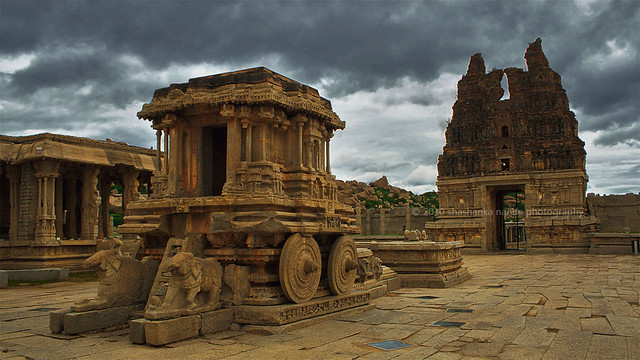
The stone chariot within the compound is a shrine in itself and a work of years of painstaking labour. "Come, I will show you musical pillars, 50 rupees only." We decide to oblige the obviously unofficial guide. He leads us to the Maha Mandapa or the chief hall and strikes the pillars and hopes that we will hear Sa-re-ga-ma. We only hear a thin metal rod striking stone. That or we are tone deaf.

A walk down the riverbank, and a ride in a coracle later we are chomping on the delectable pizzas straight from a wood fired oven. Had it not been for the paddy fields and the sound of hymns from the temples in the air - I could have very well been in Italy.
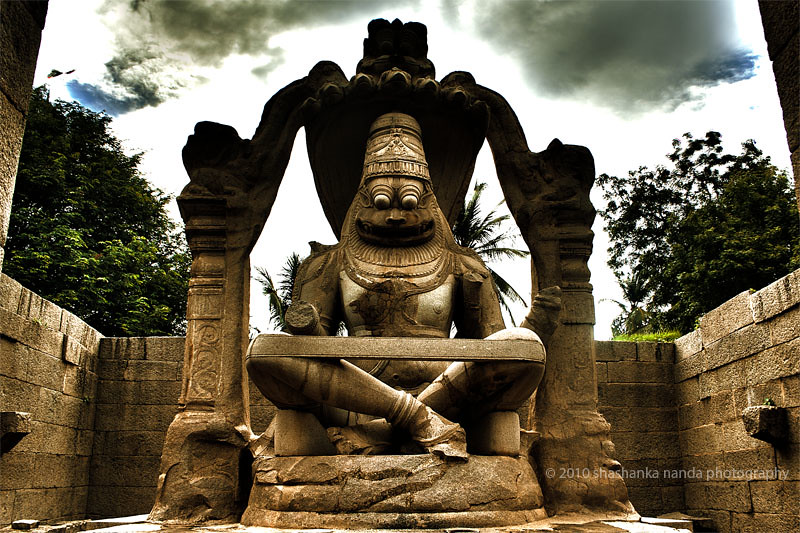
The next morning, we are face to face with the Angry God - The statue of Ugra Narasimha celebrates the legend of Prahalad who was rescued from his evil father by Vishnu, who took the form of a man-beast. Seated on (now ruined) coils of the seven headed serpent 'Sesha' and crowned by the still swollen clouds, the statue did look terrifying. Down the road from here lie the Southern group of monuments, or the Royal Enclosure. Impressive as they are, especially the Hazara Rama temple and the outlying palaces in their well manicured lawns do not evoke the same feeling as the ones set among the boulders by the riverside.
We head to the Hemkuta hill, above the Virupaksha temple and the main bazaar. Littered with shrines and cenotaphs from various eras, it is perhaps the most tranquil spot in all of Hampi. It affords a marvellous view of the temple and its surroundings. The three of us wander on our own atop the hill and I come across this little Hanuman temple when I have my 'Hampi moment'.

The setting sun has set the grey clouds alight. Birds return home and the only sound is wind weaving its way through the boulders, laden with the chime of the temple bells. I sit there alone, watching the changing colours narrate long forgotten stories of valour, grandeur, beauty and defeat.


